Driving Innovation in Battery Systems: Insights from SysCon 2026
Jump to the Section
Earlier this spring, Sigma Technology Embedded Solutions participated in the IEEE International Systems Conference (SysCon 2026) in Halifax, Canada – one of the leading global forums within systems engineering, organized by IEEE.
The conference brought together researchers, industry leaders, and engineering professionals from around the world to discuss the latest developments within systems engineering. This year’s conference covered topics such as AI in systems engineering, robotics and autonomous systems, IoT, cybersecurity, digital twins, and resilience engineering – all identified as key areas shaping the future of the industry.
A total of 245 scientific papers were submitted to the conference, with 170 accepted for presentation, highlighting both the scale and the high quality of the event. The conference provided a valuable platform for knowledge sharing, collaboration, and discussions around emerging technologies and engineering challenges.
Sigma Technology on stage
Digital twins for heterogeneous battery systems
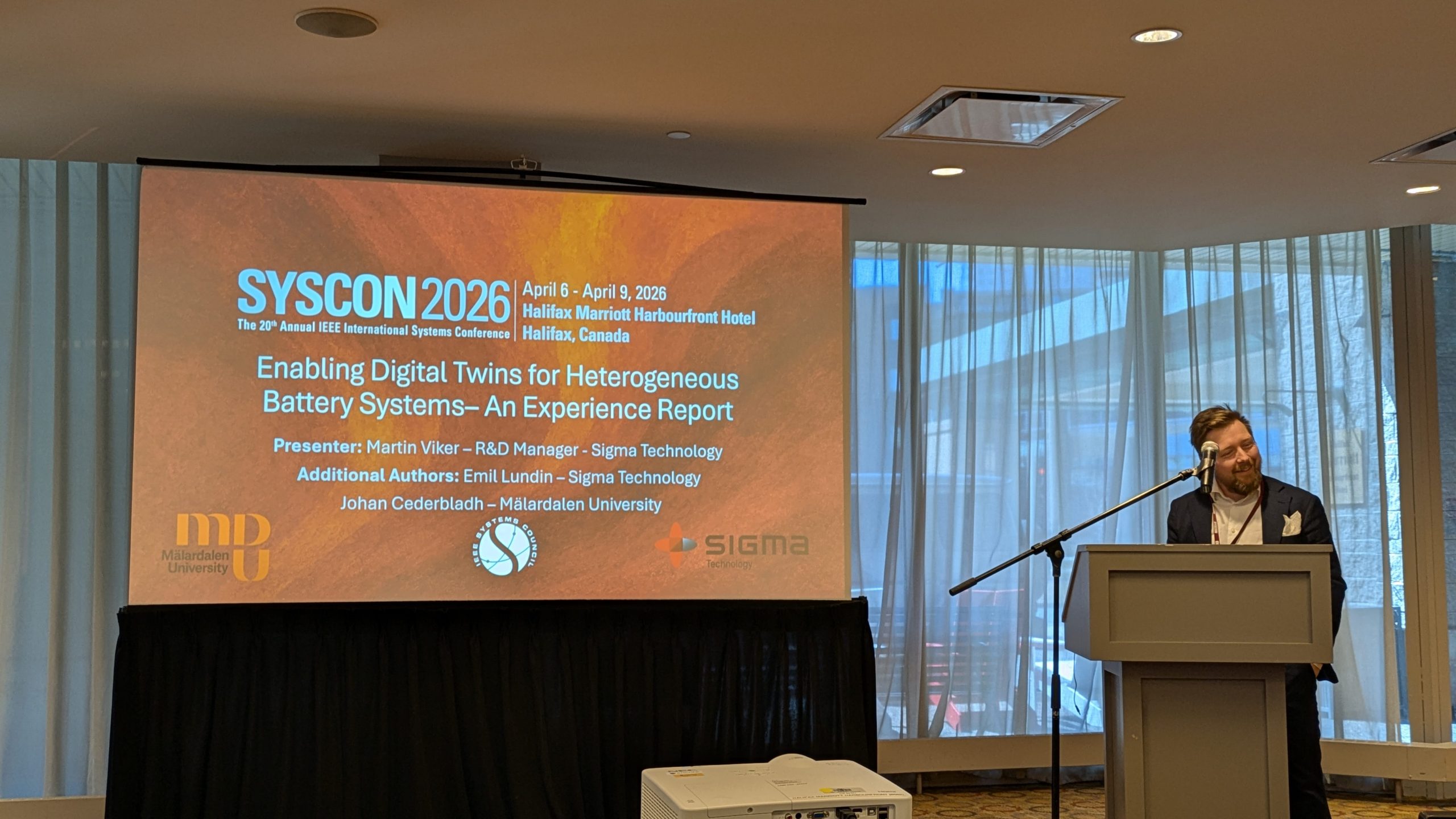
Martin Viker presenting at SysCon 2026
On-site, R&D Manager Martin Viker represented Sigma Technology by presenting the scientific paper “Enabling Digital Twins for Heterogeneous Battery Systems – An Experience Report.” The paper introduces a concept for a development platform for heterogeneous battery systems (HEBAT), aimed at supporting more efficient R&D work for battery-driven products through digital twin technology.
A collaboration between academia and industry
The project is the result of a close collaboration with Mälardalen University, where Johan Cederbladh contributed as part of his PhD research, together with Sigma consultants Emil Lundin and Martin Viker. For Martin, presenting the paper was not only a valuable opportunity to share insights, but also an important milestone for the project.
According to Martin, the response to the paper was very positive, reflecting a strong industry interest in battery-related research. The discussions that followed highlighted several potential application areas for the HEBAT concept – including runtime diagnostics and load balancing between battery systems – as well as possible use cases in new domains such as the space industry. At the same time, important challenges were raised, particularly around battery modelling, sensor data, and validation using real-world data.
Battery research is clearly a growing field, and there’s a strong interest in solutions that can support both development and operational phases Martin Viker, R&D Manager, Sigma Technology
Key learnings from 30+ sessions
In addition to presenting the paper, Martin attended more than 30 sessions during the conference, identifying several areas of high relevance for Sigma Technology’s continued R&D work.
AI in systems engineering
A key takeaway was the increasing role of AI in systems engineering. Many discussions focused on how tools such as large language models can support engineers in handling complex datasets and requirements. At the same time, Martin highlights that human expertise remains essential – especially in safety-critical and highly regulated environments.
“AI is becoming an important tool, but it’s not replacing engineers – it’s augmenting how we work,” he explains.
Rising expectations on security and resilience
The conference also highlighted rapid advancements in robotics, autonomous systems, and IoT – areas expected to evolve significantly in the coming years, with increasing demands on cybersecurity and system resilience.
Beyond the technical insights, the event also resulted in several valuable new connections with industry and research actors, opening up opportunities for future collaboration and potential business development.
Looking ahead, the next steps for the HEBAT project include developing a first prototype, conducting experiments to gather real-world data, and exploring partnerships to further validate the concept.
Staying ahead through research
For Sigma Technology, participating in international conferences like this is an important part of staying at the forefront of innovation. As Martin puts it:
“Being present at conferences like this is not only about sharing what we do – it’s about learning, building relationships, and positioning ourselves for the future.”