
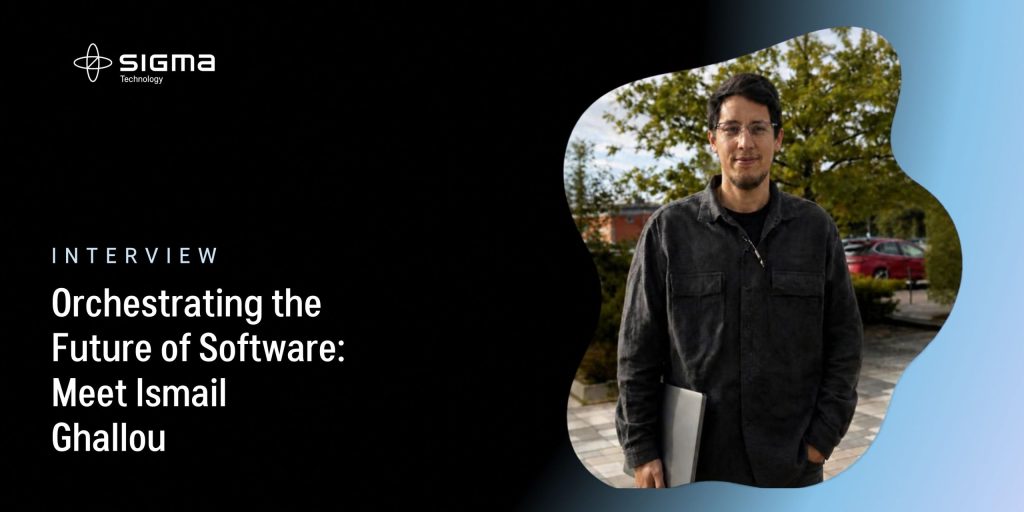
From teaching himself graphic design as a teenager to designing autonomous multi-agent AI workflows, Ismail’s career has always been driven by relentless curiosity. Today, as a consultant at Sigma Technology Software Solutions, he is actively exploring how modern developers can harness AI—shifting the focus from writing manual syntax to orchestrating intelligent systems.
Currently on assignment with a major tech enterprise in the security and IoT sector, Ismail combines a solid background in full-stack web development with a deep passion for applied machine learning. We sat down with him to talk about his journey, the concept of agentic coding, and how AI is transforming the developer role.
Ismail, how did your journey in technology begin?
It actually started with design rather than code. As a kid, I experimented with video editing and taught myself Adobe Illustrator and Photoshop. By 2016, I was freelancing for clients worldwide.
Eventually, I wanted my designs to come alive, so I picked up HTML, CSS, and JavaScript. Turning my own designs into interactive interfaces opened the door to full-stack engineering, DevOps, and mobile development. In 2017, I landed my first developer role without a formal degree, which was a huge milestone. After working in Germany for a few years, I relocated to Sweden in 2025 to join Sigma Technology.
You are deeply passionate about AI in software engineering. How do you integrate it into your daily work?
My interest in AI dates back to 2018 when I experimented with building neural networks from scratch. When advanced reasoning models and modern developer tools emerged over the past couple of years, my entire workflow changed.
On my current assignment, where security and code quality are paramount, I work with modern developer tools and structured pipelines to run automated audits, verify test suites, and keep documentation continuously updated. It’s all about creating routines where intelligent tools handle the repetitive, time-consuming tasks so developers can focus on architecture, logic, and solving actual user problems.
What is the community like on your assignment?
Even while out on a client assignment, the Sigma Technology connection remains strong. We have a great group of Sigma Technology consultants on-site across different teams, ranging from developers to QA testers. We frequently grab lunch together, bounce ideas off each other, share tech news, and discuss best practices. Having that collaborative community within your daily working environment makes a big difference.
You often emphasize “agentic coding” over “vibe coding.” What is the difference?
Vibe coding is when someone prompts an AI casually and works on intuition without much structure. It can be fun for quick prototypes, but it lacks the rigor needed for enterprise software.
Agentic coding, by contrast, operates like an agile engineering team. You initiate a goal-driven loop where a senior orchestrator coordinates multiple specialized agents: one plans the architecture, another writes the code, a third runs end-to-end tests, and a fourth audits for security and compliance. As the engineer, you supervise the workflow, provide domain context, and verify the final outcome. You are essentially directing a team of digital specialists.
How do you see the role of the software developer evolving in the coming years?
The role will shift from writing code syntax to owning outcomes.
Think of LLMs like the evolution of compilers. In the early days, programmers wrote raw binary before compilers, assembly, and high-level languages like Python abstracted the complexity away. AI is simply the next abstraction layer. We will write less manual syntax, but we will orchestrate agents, design resilient architectures, and ensure data privacy. We’ll see new specializations emerge, such as Forward Deployed Engineers and Agent Orchestrators.
What advice would you give to developers curious about diving deeper into AI?
Embrace it rather than resist it. Start building small side projects—that is honestly where you learn the fastest. Having a broad, full-stack understanding across design, front-end, and back-end provides the perspective needed to oversee automated workflows effectively.
Take time to understand the fundamentals like context windows and tool-use protocols, and don’t keep your work to yourself. Share what you build through articles, demos, or meetups. Putting your work out there connects you with great peers—in fact, that’s exactly how the Sigma Technology team discovered my work before bringing me onboard!